
AC Making a Noise It Never Made Before
The sound tells you a great deal about which component is failing — and which noises mean shut it off now.
Worth attention today
Grinding, screeching and loud metallic banging mean switch it off and call. Those noises are metal contacting metal, and the difference between calling now and calling next week is often the difference between a part and a system.
New noises are one of the more useful symptoms in this trade, because the character of the sound narrows the fault down quickly. A rhythmic sound is usually mechanical and rotating. An electrical sound is usually constant. A one-off bang at start-up is usually a component trying and failing to start. And a noise that changes with the fan speed is coming from the blower rather than the compressor.
The thing worth knowing is which sounds mean 'get it looked at' and which mean 'stop running it'. Buzzing, clicking and gurgling are usually the first category. Grinding, screeching and heavy metallic banging are the second — those are bearings, or a fan blade contacting a housing, or something loose inside the compressor, and continuing to run through them is how a repairable fault becomes a replacement.
Before you call anyone
Check these first — they cost nothing
- Note WHERE the noise is — indoor cabinet or outdoor unit. It halves the diagnosis
- Note WHEN it happens — at start-up, continuously, or when the system shuts off
- Record it on your phone if you can; it genuinely helps before we arrive
- Check the outdoor unit for obvious debris — twigs and palm fronds get into fan blades
- Check that the outdoor unit's panels and screws are not loose and rattling
- If it is grinding, screeching or banging heavily, switch the system off
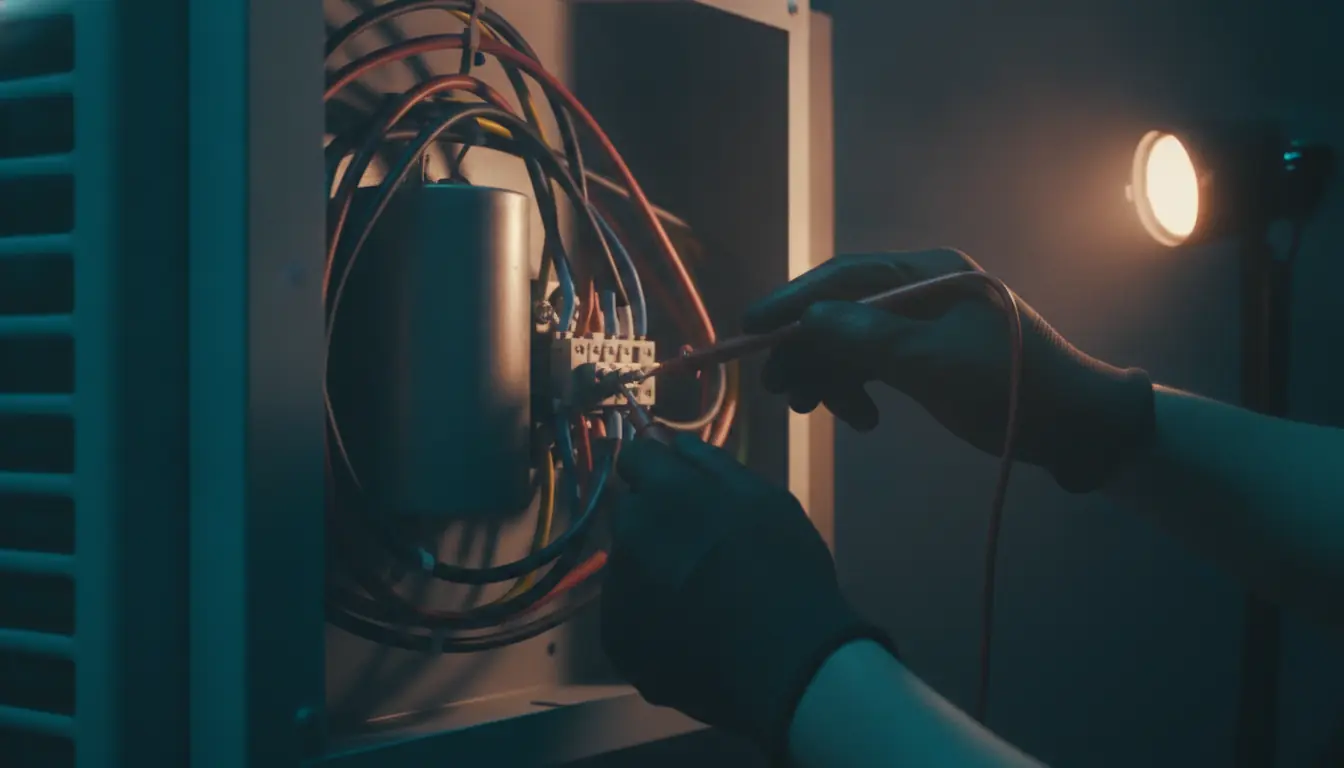
If the checks above do not resolve it, the causes below need instruments — pressures, temperature split and static pressure — rather than guesswork.
What it usually turns out to be
Screeching or squealing from the indoor unit
Usually blower motor bearings, or a belt on older equipment. It rarely improves on its own and a seized blower means no airflow at all.
Grinding from the outdoor unit
Condenser fan motor bearings, or the fan blade contacting the shroud. Switch it off — this one damages things quickly.
Loud buzzing at the outdoor unit
Typically electrical: a failing contactor or capacitor, or a compressor drawing hard and failing to start. Common precursor to the unit stopping altogether.
Rapid clicking on start-up
A relay or contactor trying repeatedly to close, or a control fault. Short-cycling like this is hard on a compressor.
Banging or clanking from the outdoor unit
Something loose — a fan blade, a mounting, or internal compressor components. The last of those is serious.
Gurgling or bubbling near the indoor unit
Often the condensate drain rather than the refrigerant circuit, though bubbling in the line set can indicate low charge. Worth distinguishing before assuming the worse one.
A rhythmic rattle that changes with fan speed
Debris in the blower wheel, or a wheel that has come out of balance. Usually straightforward once the cabinet is open.
AC Making Noise — common questions
Which noises mean stop running it immediately?
Grinding, screeching, and loud metallic banging. All three are metal contacting metal somewhere it should not, and every extra hour of running makes the repair larger. Buzzing and clicking are urgent but not usually damaging in the same way.
My outdoor unit is just loud generally. Is that a fault?
Not necessarily — older units are simply louder, and a unit against a wall or in a corner reflects sound. What matters is change. A unit that has become noticeably louder than it was is telling you something.
There is a bang when it starts and then it runs fine.
Usually a compressor or fan motor struggling to start, most often a failing capacitor. It is a cheap repair now and an expensive one after the compressor has failed trying.
Related symptoms
AC Not Turning On
Nothing happens at all — no fan, no outdoor unit, no click. Several of the causes cost nothing to rule out.
Read moreAC Not Cooling
The system is running, air is coming out, and the house still will not get to the thermostat setting.
Read moreHigh Electric Bill
In a Florida home the air conditioning is most of the bill, so a bill that jumps is usually the system telling you something.
Read moreWant someone to just look at it?
Open 24 hours, 7 days a week. Someone answers the phone at 3 AM. Not a machine.